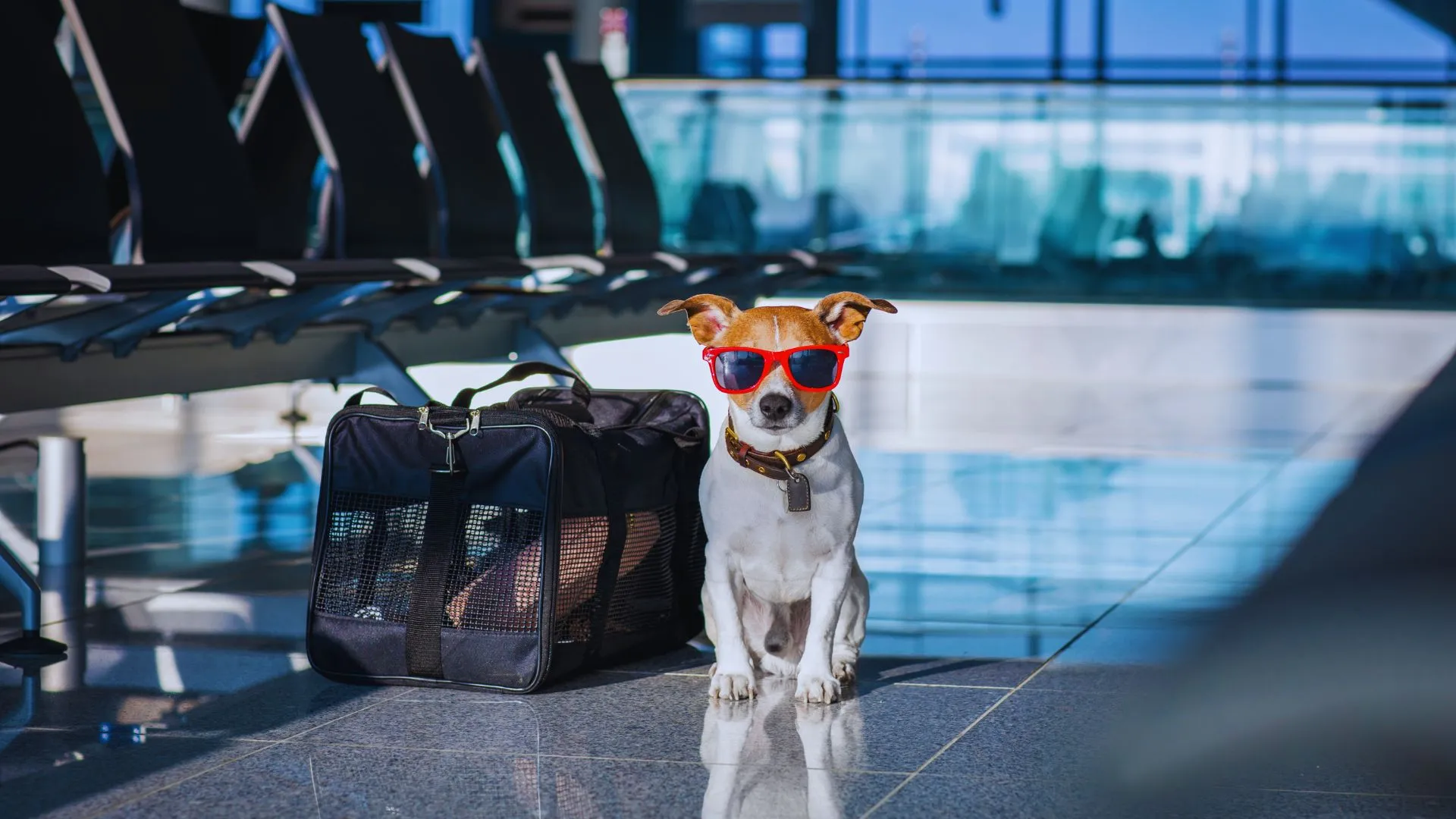
The first way your pet can travel is as carry-on baggage. People often confuse the terms excess baggage with carry-on baggage, but they are actually very different. Traveling with your pet as carry-on baggage means that your pet travels with you, their owner, in the cabin on the flight. However, there are certain requirements that make it difficult for everyone to travel with their pet this way. Most airlines require pets traveling in the cabin as carry-on baggage to fit under the seat. Additionally, and perhaps most importantly, you must accompany your pet and be on the same flight as your pet! This option is not always available for every furry traveler, but more on that later!
If you are just starting to research the logistics of moving with your pet, you might be feeling a bit nervous. One of the most common and emotionally charged questions we receive is how pets travel, especially if they are going to fly as cargo.
What is the difference between manifest cargo and excess baggage?
If you are researching the different ways your pet can travel to their new destination and wondering what the difference is between manifest cargo and excess baggage, you are not alone! So let’s start by talking about the ways your pet can travel by air.
Excess baggage
The second way to travel with your pet is by checking them as excess baggage. It might sound strange to refer to your beloved friend as “baggage.” However, what it actually means is that when you arrive at the airport, you will hand over your pet to the airline at the same place where you check your luggage.
Some airlines may charge an additional fee or “excess baggage” fee for this service. This fee is usually more expensive than flying with your pet in the cabin. Fees for sending a pet as excess baggage generally range between $100 and $200. After handing over your furry friend to the airline, you will pick up your pet upon landing at your new destination.
Important things to keep in mind:
- Even though they travel as “baggage,” animals always fly in pressurized, climate-controlled holds.
- Pets flying as excess baggage may be subject to strict temperature and breed restrictions for traveling as excess baggage.
- Because animals transported as excess baggage travel alongside luggage, airlines will not expose animals to temperatures below 45 degrees Fahrenheit unless accompanied by a veterinary certificate stating that the pet can tolerate lower temperatures. If outdoor temperatures are deemed unsafe for your pet, then your pet will not be able to fly that day.
Manifest cargo
Manifest cargo is the best option for pets traveling without their owners, as it does not require the owner to be on the same flight. This allows owners to travel to their new destinations earlier and ensure everything is set up for the arrival of their furry family. Pets traveling as manifest cargo and as excess baggage travel in the baggage compartment, in a pressurized and climate-controlled area reserved only for pets. However, unlike pets traveling as excess baggage, pets traveling as manifest cargo can be tracked throughout their journey using an AWB or Airway Bill number. Shipping pets as manifest cargo is usually more expensive than transporting them as carry-on and excess baggage. But there are some advantages for a pet traveling as manifest cargo.
Your pets are typically transported in climate-controlled vehicles to and from the plane. Pets are loaded last onto the plane and unloaded first upon landing. Therefore, their time on the tarmac is limited. Airlines employ and train dedicated staff to handle animals properly and safely, guaranteeing your pet a safe and smooth flight. Finally, unlike pets traveling as excess baggage, pets flying as manifest cargo must be delivered to the airline at their cargo terminal at the airport (not at the baggage counter!). Pets booked as manifest cargo will be received for pick-up at the arrival airport’s cargo terminal.
In summary:
Carry-on Baggage
- You must travel with your pet
- The pet must fit under your seat
- Subject to certain size and breed restrictions
- Cheaper than excess baggage or manifest cargo
Excess Baggage
- You must travel with your pet
- Pets are handed over to the airline at the baggage counter
- Strict temperature and breed restrictions
- More expensive than carry-on baggage
Manifest Cargo
- Owners do not have to travel with their pets
- Pets are handed over to the airlines at their cargo terminal
- Pets travel with an AWB to track their location
- Pets are the last to board and first to disembark the plane
- More expensive than excess baggage
- A freight forwarder is usually required to handle the booking
Pets flying in cargo: Myths and realities
There are many myths about shipping pets as cargo, so we thought we would review and debunk the most common myths here. We hope this eases any pre-travel concerns about moving with your four-legged family members this way! Pet Lounge arranges hundreds of pet flights in cargo every year. So let’s jump right into the common myths about flying cats and dogs as cargo, and share the reality based on nearly 10 years of experience.
Myth: The pet cargo hold is dangerously hot or cold.
Reality: Cargo is climate controlled on most aircraft.
On most flights that accept pets, the cargo area is climate controlled, just like the passenger cabin above. So why do airlines have temperature restrictions? While many airlines enforce “weather embargos” during the summer/winter months, it is not because of the temperature inside the hold. Non-pet-friendly airlines carry all their cargo to the aircraft at the same time. Animals often end up waiting on the tarmac while baggage is loaded or unloaded. This waiting time on the tarmac is the reason for weather embargos and can be the most dangerous thing for pets, not the flight itself. We only work with pet-friendly airlines that keep pets in climate-controlled environments throughout the entire journey. This means we can move pets year-round without temperature embargos. Working with these select airlines, all pets are kept in a climate-controlled area in the airline’s cargo offices until all people and baggage have been loaded onto the aircraft. Then, pets are transported in climate-controlled vehicles and loaded onto the plane, meaning they never sit outside on the tarmac waiting. Afterward, when the plane lands, pets are the first to be unloaded and taken back to the climate-controlled area in the cargo offices for pets.
Myth: The pet cargo hold is not pressurized.
Reality: Cabin and cargo pressure is the same on most flights.
On most large “wide-body” aircraft, the pressure in the cargo hold is the same as in the upper cabin. Just as Pet Lounge only works with pet-friendly airlines that keep pets in climate-controlled environments throughout their journey, we only book pressurized flights for all live animal transportation. The air humans breathe in the cabin is the same air that circulates through the lower part of the plane.
Myth: Isn’t it safer to just drive my pet?
Reality: Driving a pet is not necessarily safer than flying.
Unless you plan to drive your pet yourself or have a friend drive them, it is safer and faster to relocate your pet by air than to hire a ground transportation company. Long-distance ground transportation can be more stressful for a pet than flying, and potentially more dangerous due to the time it takes, the variation between ground transportation companies, and the number of stops/starts/rest breaks involved. We have a network of vetted ground transportation partners that we hire when a pet needs to be transported this way, because there are cases where pets cannot fly due to breed restrictions, weather, or lack of flight availability, and we wouldn’t trust just any driver with your most valuable cargo.
Myth: Pets should be sedated before a flight to reduce stress.
Reality: Sedating your pet before a flight is not safe!
- Tranquilizers suppress the respiratory system, making it difficult for a pet to adapt to changes in altitude and temperature. This is particularly true for “flat-faced” breeds like bulldogs and pugs.
- A pet may react differently to the same drug, at the same dose, depending on their state of excitement and altitude. No studies have been conducted to determine the effect of tranquilizers on pets at high altitudes, so we do not recommend sedating your pet before a flight.
What do we recommend instead? Crate training, crate training, crate training! A pet that has become accustomed to its travel crate well in advance will experience much less stress when flying.
What are the similarities between excess baggage and manifest cargo?
- Pets fly underneath the aircraft in a climate-controlled and pressurized cargo hold.
- Pets must always travel in airline-approved travel crates.
- Airlines will require a health certificate issued by a veterinarian prior to travel (usually within 10 days prior to departure).
- Space must be booked in advance (often at least 24-48 hours, depending on the airline).
What are the differences between excess baggage and manifest cargo?
Unaccompanied travel
When a pet travels as excess baggage, it must be linked to its owner’s flight reservation. However, the best flight for you may not be the best flight for your pet. If you take your pet as excess baggage, Pet Lounge cannot arrange that booking for you or provide assistance on the day of travel. Be sure to contact your airline for schedules and check-in procedures.
When a pet travels as manifest cargo, it is booked on its own ticket (called an Air Waybill or AWB). This means your pets can arrive before or after you. Many owners like this option because it gives them time to prepare their new home so the pet arrives to a calm and happy environment (rather than a chaotic moving day). When your pet travels as manifest cargo, Pet Lounge can manage the flight booking and all check-in details on your behalf.
Restrictions on the number of pets
Many airlines only allow two pets to be booked as excess baggage. For some larger families, that simply doesn’t work. If you have more than two pets, manifest cargo is not only the safest option—it is often the only option.
Layovers
If you fly your pets as excess baggage, a layover can be an extra challenge for your travel plans. For all types of live animals, most airlines require the owner to ensure they are checked in for the connecting flight. This can add unnecessary headaches to your trip, especially if your layover is short.
If you fly your pets as manifest cargo, the airline has strict regulations on how to handle pets during a layover. Lufthansa’s Animal Lounge in Frankfurt is a great example! When a pet travels as manifest cargo and stops at the Frankfurt Animal Lounge, the pet is fed and cared for by trained handlers before being checked in for their connecting flight.
Country restrictions
Finally, some countries require pets to arrive as manifest cargo. Australia, for example, does not allow pets to arrive in the cabin or as excess baggage. So, if your family is planning to move “down under,” there is only one acceptable mode of transportation.
Why manifest cargo is our preferred option:
Every year we relocate more than 2,000 pets, and the vast majority fly as manifest cargo without issue. We prefer manifest cargo because:
- This method gives our clients the freedom to make the travel arrangements that work best for them.
- Manifest cargo routes allow families with multiple pets to travel together.
- Airlines are trained to handle pets during layovers.
- All countries accept pets arriving as manifest cargo.
Excess baggage and how we can still help:
Pet Lounge can still help you if traveling as excess baggage is the best fit for your pet. Our team of experts can assist you in choosing the right travel crate, offer crate acclimation tips, guide you through veterinary visits, manage import permits (if applicable), and handle government endorsements. However, we will not be able to assist with anything related to your flight, such as booking the flight, the check-in process, or customs clearance upon arrival in your new country.